Kingdom Hearts 2 is my favourite game of all time – it has been ever since one of my old school friends, who knew I was a big fan of the first game, let me borrow it and I spent the next few months playing it non-stop. However, while the first game isn’t on the level of the second, it still holds a very special place in my heart. I make a habit of going back to it every few years or so to experience that same magic I felt as a 9-year-old kid and even now, two decades later, the magic remains. From the moment I heard Sora’s opening monologue followed by the opening scene with Hikaru Utada’s “Simple & Clean” playing, I was in love and I don’t think any piece of media will ever enthral me the way Kingdom Hearts has – at least nothing has in the 24 years since its release.

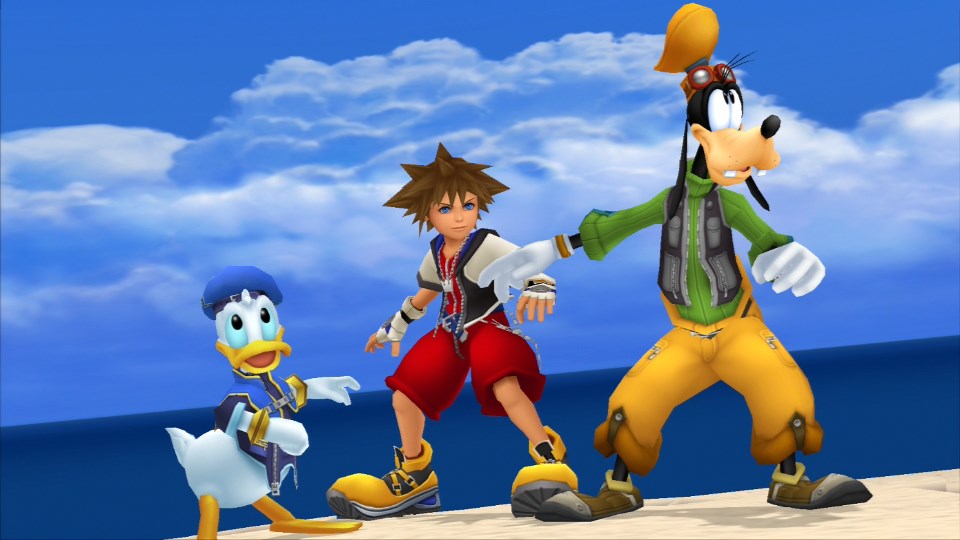
The game follows Sora – a young boy living an uneventful life on Destiny Islands with his two best friends, Riku and Kairi. Their lives are changed however when a strange, dark energy swallows their island and separates them across different worlds. Sora is chosen by the mysterious “Keyblade” – a weapon that can vanquish darkness and restore light – and sets out to find his lost friends. Shortly after, he teams up with Disney icons, Donald Duck and Goofy who have been tasked by the missing King of their world, King Mickey, to find the wielder of the Keyblade. The trio then travels from world to world on a small spacecraft known as the Gummi Ship as they look for Sora’s friends and King Mickey, as well as save each of these worlds from meeting the same fate as Destiny Islands.
The levels, or “worlds” as they are known as in the game, are mostly based on animated Disney movies. Deep Jungle has you teaming up with Tarzan to protect his Gorilla friends from the evil Clayton; in Atlantica, Ariel joins your party as you work together to stop Ursula from taking over the seas; Jack Skellington must learn what it means to have a heart in Halloween Town; you must help Aladdin save Jasmine from Jafar in Agrabah – these are the stories and characters we’ve come to know and love from their respective films, but it’s amazing how well these stories mesh with Kingdom Hearts’ own lore. Not just the stories though, the anime-inspired art style of the game doesn’t look out of place alongside Disney’s own style.
As mentioned before, Sora’s goal in each world is to save them from being swallowed by darkness brought forth by those with dark hearts – characters like the aforementioned Clayton, Ursula and Jafar are examples of these as they command the enemies known as The Heartless – shadowy figures born when people lose their heart to darkness. Battling The Heartless is one of the areas where the game shines. The combat is fast-paced – you use the Keyblade to string together combos to defeat your enemies which, at first, is quite simple but as you unlock and equip abilities and learn to use magic it becomes a lot deeper. As you progress through the game, you also unlock various “Keychains” – attachments that allow Sora’s Keyblade to take different forms. These aren’t just cosmetic though – they each come with different stats, so you can experiment with different combat styles. Do you want Sora to specialise in aerial combat? Equip abilities like Air Combo Plus and dominate opponents in the air. Would you rather strike from range? Equip the Spellbinder Keychain to increase Sora’s MP reserve and shoot fire, lightning and ice from across the battlefield, while not giving your opponent the chance to retaliate. There’s a great deal of depth in regard to the game’s combat and it’ll require you to become proficient in each aspect as some of the challenges – namely the boss fights – will push you to your limit.

I mentioned Simple & Clean earlier, which is just one of the many incredible songs that make up the soundtrack. You’ll hear instrumental variations of iconic Disney songs like “This is Halloween” and “Under the Sea” but the game’s original tracks are really where the OST shines – Yoko Shimomura truly created magic here. “Dearly Beloved”, in my opinion, is the greatest start menu music in the history of video games; Kairi’s theme is absolutely beautiful; the boss theme’s are easily some of my favourite across the medium (just listen to “The Deep End”, “Forze Del Male”, “Destiny’s Force” or “Shrouding Dark Cloud”); and the themes for each world set the tone extremely well – like the “Traverse Town” theme being comforting to reflect that Sora is in a safe place, or the “Hollow Bastion” theme feeling tense, reflecting the fact that the situation, at that point in the story, has become increasingly desperate.

As for the story, it’s quite straightforward (nothing like the subsequent games in the series but that’s a topic for another day) – Sora is travelling across the various worlds to find his lost friends. You won’t find any complex lore or crazy twists here, but the narrative’s charm comes from its characters. Sora is impossible not to love – he instantly brightens up every scene he’s in, always managing to stay optimistic even after losing almost everything (“no sad faces” becomes the main trio’s catchphrase). He’s exactly the type of friend anyone would be lucky to have – he never once wavers in his belief that Riku and Kairi are out there, somewhere. Then you have Donald and Goofy who are equally as likable – the trio form an unbreakable bond of friendship which is tested on several occasions, and on each occasion that bond only becomes stronger. Kairi is sadly underused, but Riku has an incredibly compelling character arc, serving as Sora’s best friend and rival as he battles his own inner darkness. As well as Disney characters, you’ll also meet several characters from developer Square Enix’s flagship RPG series, Final Fantasy. The likes of Leon, Cloud, Yuffie and Aerith all play very minor roles in the story, but unfortunately don’t have much of an impact which is a shame because they’re all fantastic characters in their own games, so I would’ve liked to have seen them be more involved. Also, the game’s main villain doesn’t show up until very late in the game, meaning he has little screen time and the few times he does appear, doesn’t really offer much other than being a generic evil-for-evil’s-sake type of villain.

Those negatives aside, I still adore this game so it might seem strange I’d have a hard time recommending it to someone who has never played it. Visually it looks fine (especially with the remastered version that released in 2013) but the gameplay might be difficult to stomach for people who have become accustomed to modern games. The platforming is janky and awkward, the combat is stiff compared to modern action games like Nier and Stellar Blade, and not all of the cutscenes are voiced (which probably isn’t as much of an issue to people who play a lot of JRPG’s, but it’s still noteworthy). However, if you’re able to look past all of that and are eager to experience the series for the first time, then I’d implore you to play this game and I hope it captures you the same way it did to me.


Leave a Reply